Quick answer: Credit utilization is the percentage of your available credit card limits that you’re using. To calculate it, divide your total card balances by your total limits. Many experts suggest staying below 30%, and lower is often better. Because most scoring models recalculate it each month, lowering utilization is one of the quickest ways to improve your score. Results vary.
By Miguel Hernandez Lopez | Updated November 2026
Few credit factors can change as quickly as utilization. A single large payment can move it in one billing cycle. Even so, many people misunderstand how it works. This guide explains the calculation, the target to aim for, and the steps that help most.
What Credit Utilization Means
Credit utilization measures how much of your revolving credit you use. Revolving credit mainly means credit cards and lines of credit. It does not include installment loans, such as auto loans, student loans, or mortgages.
Scoring models treat high utilization as a sign of risk. Someone who uses most of their available credit may have trouble paying it back. Conversely, low utilization suggests you manage credit well.
In most scoring models, utilization is part of the “amounts owed” category. For FICO scores, that category carries roughly 30% of the weight. Payment history carries more, but utilization often moves faster. Check the current weights on the official FICO website, since models change.
How to Calculate Your Credit Utilization
The formula is simple:
Utilization = (Total card balances ÷ Total credit limits) × 100
For example, if your cards have a combined $2,000 balance and a combined $10,000 limit, your utilization is 20%.
Overall and per-card utilization
Scoring models generally look at two things. The first is your overall utilization across all cards. The second is the utilization on each individual card. A maxed-out card can hurt your score, even if your overall rate looks fine.
Where the numbers come from
Card issuers typically report your balance to the credit bureaus once a month. That date is often your statement closing date, not your due date. As a result, the balance on your statement is usually the one that gets reported. Remember this point, because it affects your strategy.
What Is a Good Credit Utilization Ratio?
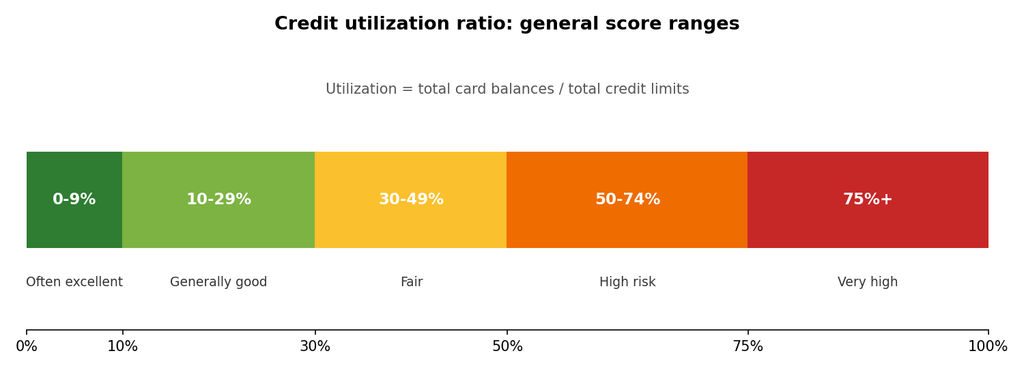
No official magic number exists. Still, the following ranges are a useful guide.
| Utilization | General view |
|---|---|
| 0% to 9% | Often viewed as excellent |
| 10% to 29% | Generally good |
| 30% to 49% | Fair, may start to hurt |
| 50% to 74% | High risk |
| 75% and above | Very high, can hurt a lot |
The 30% mark is a common guideline, not a rule. Consumers with very high scores often have single-digit utilization, according to industry data. Even so, scoring models differ, so treat these as general ranges.
A balance of zero across every card is fine, but a small reported balance may score slightly better in some models. This is not a reason to carry debt, though. You can pay your statement in full each month and still show a small balance on the report.
Example: Lowering Utilization Across Three Cards
The following case is illustrative only. Actual score changes vary.
Jordan has three cards with a combined limit of $10,000. Her balances put her overall utilization at 40%.
| Stage | Card A ($4,000 limit) | Card B ($3,000 limit) | Card C ($3,000 limit) | Overall |
|---|---|---|---|---|
| Starting point | $2,800 | $1,200 | $0 | 40% |
| Pay $1,000 to Card A | $1,800 | $1,200 | $0 | 30% |
| Pay off Card A, reduce Card B | $0 | $900 | $0 | 9% |
Jordan lowers her utilization from 40% to 9%. To get there, she pays down $3,100 in total. In many cases, this kind of change leads to a higher score. The exact amount depends on the rest of her credit file.
Notice that Card A started at 70% utilization ($2,800 on a $4,000 limit). That single card could have hurt her score on its own. Paying it down first helps in two ways.
Seven Ways to Lower Your Credit Utilization
Several tactics can reduce your utilization. Pick the ones that fit your situation.
1. Pay down balances
This is the most direct fix. Focus first on cards with the highest utilization. If you also want to save on interest, compare approaches in Debt Snowball vs Debt Avalanche: Which Saves More Money?.
2. Pay before the statement closes
Since issuers report the statement balance, a payment before the closing date can lower what gets reported. For instance, suppose you charge $1,500 on a $5,000 card. If you pay it in full before the statement closes, the report may show 0%. If you wait until the due date, it may show 30%.
3. Make more than one payment per month
Splitting payments through the month keeps the balance lower at all times. It also helps if your spending is high but you can pay as you go.
4. Ask for a credit limit increase
A higher limit lowers utilization, as long as your balance stays the same. For example, raising a $5,000 limit to $7,500 with a $1,500 balance drops utilization from 30% to 20%. Ask whether the issuer will use a soft or hard inquiry first. A hard inquiry can lower your score slightly. Also, don’t use the extra room to spend more.
5. Keep old cards open
Closing a card removes its limit from your total. That can raise your utilization overnight. Therefore, keep no-fee cards open, and use them lightly. Read more in How Debt Payoff Affects Your Credit Score.
6. Spread balances across cards
If one card is maxed out and others are empty, consider moving some of the balance. A balance transfer may help, but it has fees and rules. Compare the cost in Balance Transfer Cards: Are They Worth It for Debt Payoff?.
7. Consider a consolidation loan
A personal loan can pay off your card balances and move the debt to an installment account. Your card utilization may drop sharply. However, you take on a new loan, and you must avoid running up the cards again. See Debt Consolidation Loan vs Balance Transfer: Which Is Better? and Does Debt Consolidation Hurt Your Credit Score?.
How Fast Does Utilization Affect Your Score?
Most scoring models don’t remember past utilization. They look at the numbers on your latest reports. Consequently, lower balances can show up after your next reporting cycle, often within 30 to 45 days.
Some newer models, such as FICO 10T and VantageScore 4.0, also consider trends over time. These versions reward consistent low balances. Lenders use many different models, so your results may vary.
You can speed things up by checking your reports for free at AnnualCreditReport.com. Look for the reported balances and limits, and confirm they match your records. If you find an error, follow How to Dispute Errors on Your Credit Report.
Common Utilization Mistakes
Several habits can undo your progress:
- Closing a card right after paying it off. It reduces your available credit.
- Paying only after the due date. The statement balance may already be reported.
- Maxing out one card. Per-card utilization matters too.
- Running up balances after a limit increase. The benefit disappears.
- Using a balance transfer and charging the old card again. You double your debt.
- Believing you must carry a balance. You don’t need to pay interest to build credit.
If your balances feel too large to manage, see How to Pay Off Credit Card Debt Fast: 7 Strategies That Work. You can also lower your costs with How to Negotiate a Lower Credit Card APR.
A Simple Action Plan
Use this checklist to put the ideas into practice:
- List every card, its limit, and its balance.
- Calculate your overall and per-card utilization.
- Find each card’s statement closing date.
- Make a payment a few days before each closing date.
- Target any card above 50% first.
- Keep paid-off cards open if they have no fee.
- Recheck your reports in a month.
To estimate how long payoff will take, try our Credit Card Payoff Calculator (Minimum vs Extra Payments).
Frequently Asked Questions
What is a good credit utilization ratio?
Many experts suggest staying below 30%. Lower is often better, and single digits are common among people with excellent scores. No official number exists, so use these as a guide.
Does credit utilization matter if you pay in full each month?
It can. Issuers usually report the statement balance, which may be high even if you pay it off. Paying before the statement closes can lower the reported amount.
How quickly does lowering utilization raise your score?
Often within one or two billing cycles. Most models recalculate it each month. Some newer models also look at trends, so steady habits help.
Does utilization affect your score if you have no balance?
A zero balance doesn’t hurt you. Some models may rate a small reported balance slightly better than none, but the difference is minor. Don’t carry debt for this reason.
Does closing a credit card hurt your utilization?
Yes, it can. Closing a card lowers your total available credit, which may raise your utilization. Keep no-fee cards open when you can.
Do installment loans count toward credit utilization?
No. Utilization applies to revolving accounts, such as credit cards. Installment loans, like car loans and mortgages, are treated separately.
Does a credit limit increase help?
It can, if your balance stays the same. A hard inquiry may cause a small, temporary dip. Avoid spending more because of the higher limit.
The Bottom Line
Credit utilization is one of the most controllable factors in your score. Calculate your ratio, pay balances down, time your payments before the statement date, and keep your cards open. Changes may appear within a month or two, although results vary.
Next, read How to Rebuild Credit After Paying Off Debt for the longer game. For general consumer guidance on credit reports and scores, the Consumer Financial Protection Bureau also offers free resources.
This article is for educational purposes only and is not financial, legal, or tax advice. Credit scoring models and issuer practices vary and change over time. Consult a qualified professional about your specific situation.